

Tehran’s response to Trump’s threat signals a potentially dangerous escalation as both sides menace sites relied on by millions
-
Middle East crisis live – latest updates
Smoke rises above Tehran after an Israeli airstrike on Sunday evening. Photograph: Anadolu/Getty Images
Tehran has said it will “irreversibly destroy” essential infrastructure across the Middle East, including vital water systems, if the US follows through on Donald Trump’s threat to “obliterate” Iran’s power plants unless the strait of Hormuz is fully opened within two days.
As Iranian missiles struck two southern Israeli cities overnight, injuring dozens of people, and Tehran deployed long-range missiles for the first time, the developments signalled a dangerous potential escalation of the war, now in its fourth week, with both sides threatening facilities relied on by millions of people.
The speaker of the Iranian parliament, Mohammad Bagher Ghalibaf, said on Sunday that vital infrastructure in the region – including energy and desalination facilities – would be considered a legitimate target and would be “irreversibly destroyed” if his country’s own infrastructure was attacked.
Amnesty International said this month there was a substantial risk that attacks on systems providing essential services such as electricity, heating and running water would violate international law and “in some cases could amount to war crimes” because of the potential for “vast, predictable, and devastating civilian harm”.
The Iranian military’s operational command headquarters, Khatam al-Anbiya, said Iran would strike “all energy, information technology and desalination infrastructure” belonging to the US and Israel in the region.
The statement also said that if Trump’s threat was carried out, the strait of Hormuz would be “completely closed, and will not be reopened until our destroyed power plants are rebuilt”.
Iran’s president, Masoud Pezeshkian, said “threats and terror” were “only strengthening Iranian unity”, while the “illusion of erasing Iran from the map” showed “desperation against the will of a history-making nation”The US president said on Saturday that he was giving Iran 48 hours – until shortly before midnight GMT on Monday – to open the strait of Hormuz, a vital pathway for the world’s oil flows, or the US would “hit and obliterate” Iranian power plants “starting with the biggest one first”.
The US ambassador to the UN, Mike Waltz, defended Trump’s threat on Sunday, insisting that Iran’s Islamic Revolutionary Guard Corps (IRGC) controlled much of the country’s infrastructure and used it to power its war effort.
He said Trump would start by destroying one of Iran’s largest power plants, but did not identify it. “There are gas-fired thermal power plants and other type of plants,” and “the president is not messing around”, he said.
Iran’s representative to the International Maritime Organisation, Ali Mousavi, said on Sunday that the strait was open to all shipping except vessels linked to “Iran’s enemies”, with passage possible by coordinating security arrangements with Tehran.
Iranian attacks have in effect closed the narrow strait, which carries about a fifth of global oil and liquefied natural gas supplies, causing the world’s worst oil crisis since the 1970s and sending European gas prices surging by as much as 35% last week.
Only a relatively small number of vessels, estimated at about 5% of the prewar volume, from countries that Tehran considers friendly – including China, India and Pakistan – have been allowed to pass.
A Tehran billboard featuring a portrait of the late supreme leader Ayatollah Ali Khamenei. Photograph: AFP/Getty Images
More than 2,000 people have been killed in Iran since 28 February, when the US and Israel began their attacks, and Tehran in turn has struck targets in Israel and the Gulf states. Lebanon was drawn in after Iran-backed Hezbollah attacked Israel.
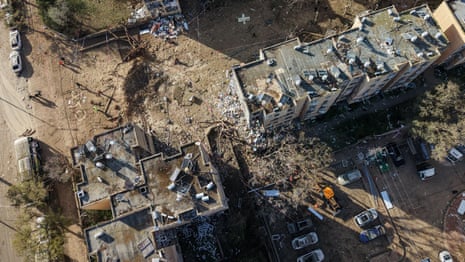
Air-raid sirens sounded across Israel from the early hours of Sunday morning, warning of incoming missiles from Iran after scores of people were injured overnight in two separate attacks on the southern towns of Arad and Dimona.
The Israeli army said on Sunday morning that it would strike Tehran in retaliation. The country’s prime minister, Benjamin Netanyahu, said during a visit to Arad that senior IRGC commanders would be pursued.
“We’re going after the regime. We’re going after the IRGC, this criminal gang,” he said. “We’re going after them personally, their leaders, their installations, their economic assets.”
The Iranian health ministry spokesperson, Hossein Kermanpour, said patients had been evacuated from the Imam Ali hospital in the south-west city of Andimeshk on Sunday after an airstrike a day earlier.
Israel’s military said it had not been able to intercept the missiles that hit Dimona and Arad, the nearest large towns to the country’s nuclear centre in the Negev desert, which houses what is widely believed to be the Middle East’s only nuclear arsenal.
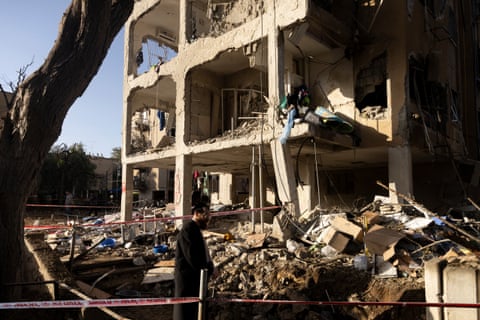
Bomb damage in Arad, Israel. Photograph: Amir Levy/Getty Images
Israel has never admitted to possessing nuclear weapons, insisting that the site is for research. The strikes marked the first time that Iranian missiles had penetrated Israel’s air defence systems in the area.
Iran said the attacks had been launched in response to a strike on its main nuclear enrichment facility at Natanz on Saturday. Israel denied responsibility for the attack and the Pentagon declined to comment.
In Tel Aviv, 15 more people were injured on Sunday morning in a separate incident involving a cluster bomb. The attacks are adding to mounting pressure on Israel’s air defence systems as Iranian strikes increasingly test their limits.
The World Health Organization said that the war was at a “perilous stage” and called for restraint. “Attacks targeting nuclear sites create an escalating threat to public health and environmental safety,” the WHO director general, Tedros Adhanom Ghebreyesus, said.
Tehran also fired long-range missiles for the first time on Saturday, the Israeli military chief, Eyal Zamir, said. Two ballistic missiles with a range of 2,500 miles (4,000km) were fired at the US-British Indian Ocean military base at Diego Garcia, he said.
The British cabinet minister Steve Reed said one missile had fallen short and the other had been intercepted. There was no assessment backing claims that Iran was planning to strike Europe, he said
The Israel Defense Forces had said Iran had missiles that could reach London, Paris or Berlin, but Reed said he was not aware of any assessment at all that Iran was even trying to target Europe, “let alone that they could if they tried”.




0 Comments